
Embracing Vulnerability
A Path to Authentic Connection and Healing
I recently heard the expression “clean vulnerability.” It made me pause, and it rippled inside…
We speak more openly about vulnerability today than we once did. This is a good thing. Naming our experience matters. It allows us to reclaim aspects of ourselves that have long been hidden behind competence, performance, or quiet shame. But the phrase “clean vulnerability” stirred something more subtle in me. To me, it suggested that not all experiences of vulnerability are the same, and there may be ways of being vulnerable that are clear, grounded, and life-giving and other ways that entangle us or others.
Being human means being vulnerable. Not occasionally, but continuously.
We are vulnerable in the face of change.
In impermanence.
In aging.
In loving.
In losing.
In being misunderstood.
In being seen or rejected.
We are vulnerable because we care. Because we are porous. Because we live in relationship with forces larger than ourselves…
The question is not whether vulnerability exists. It is how we meet it.
Do we deny it?
Fear it?
Overprotect it?
Collapse into it?
Or can we learn to appreciate and inhabit it in a way that keeps us open, connected, and whole?
The Armoured Heart
If vulnerability feels unsafe, unacceptable, or overwhelming, we naturally defend against it. We close, cover up, distract ourselves. We strengthen our outer identity — competence, control, independence. We learn to speak confidently even when something trembles underneath. We become self-sufficient, efficient, capable…
And these qualities are certainly not wrong. They are often adaptive and help us survive. But when vulnerability is disowned and pushed underground, we reduce ourselves. Our vulnerability does not disappear. It waits while not wanted and is even more vulnerable in that isolation. Unattended vulnerability often becomes more fragile, more reactive, more easily triggered. We may not consciously feel it, but it shapes our responses. It tightens our tone. It narrows our judgments and capacity to remain open in relational dynamics, and especially in conflicts. The armour protects — but it also isolates.
Over time, we may begin to feel disconnected from others and from our own depth and essence. We function well, perhaps even impressively, yet something vital is missing or feels muted. The cost of armouring is a reduced sense of vitality and aliveness.
The Flooded Heart
At some point, many of us recognise that hiding vulnerability is not sustainable. We hear that vulnerability is strength. We decide to be more open and - this is a courageous movement. Yet sometimes the pendulum swings. Instead of suppressing vulnerability, we release it all at once. We share everything, often impulsively and maybe naively. We expose raw emotion without inner grounding and processing it first. We hope that honesty alone will bring relief. There may be a momentary sense of freedom — like pressure released from a valve. But afterwards, something can feel unsettled.
When vulnerability is expressed without inner holding, it often depends heavily on how others respond. Will they reassure me? Rescue me? Affirm me? Judge me? Unconsciously, we may ask others to regulate what we have not yet regulated and fully owned and integrated within ourselves.
This kind of expression is human, and it often arises from a genuine longing for connection. However, it ends up feeling more like exposure that feels messy, entangled, and dependent. It lacks something…. It lacks holding ground.
Clean Vulnerability: The Grounded and Supported Way
When I can sense what is tender within me and stay with it, feel it in my body, breathe with it, respectfully listen to it — something shifts. My vulnerability is then internally held and welcomed.
It is not hidden.
It is not dramatised.
It is not pushed outward in search of rescue.
It is received, felt, and in that welcoming, I discover that I can be vulnerable and strong at the same time.
Not strong in the rigid sense. Not strong in the defensive sense. But strong as in rooted.
Aware of my inner state, while still in contact with the world around me. Open, yet not losing myself. Soft, yet not collapsing. This state has, for me, the quality of a river.

Clean vulnerability emerges when we neither armour nor flood. It arises when we remain present and connected with our vulnerability before expressing it.
The River
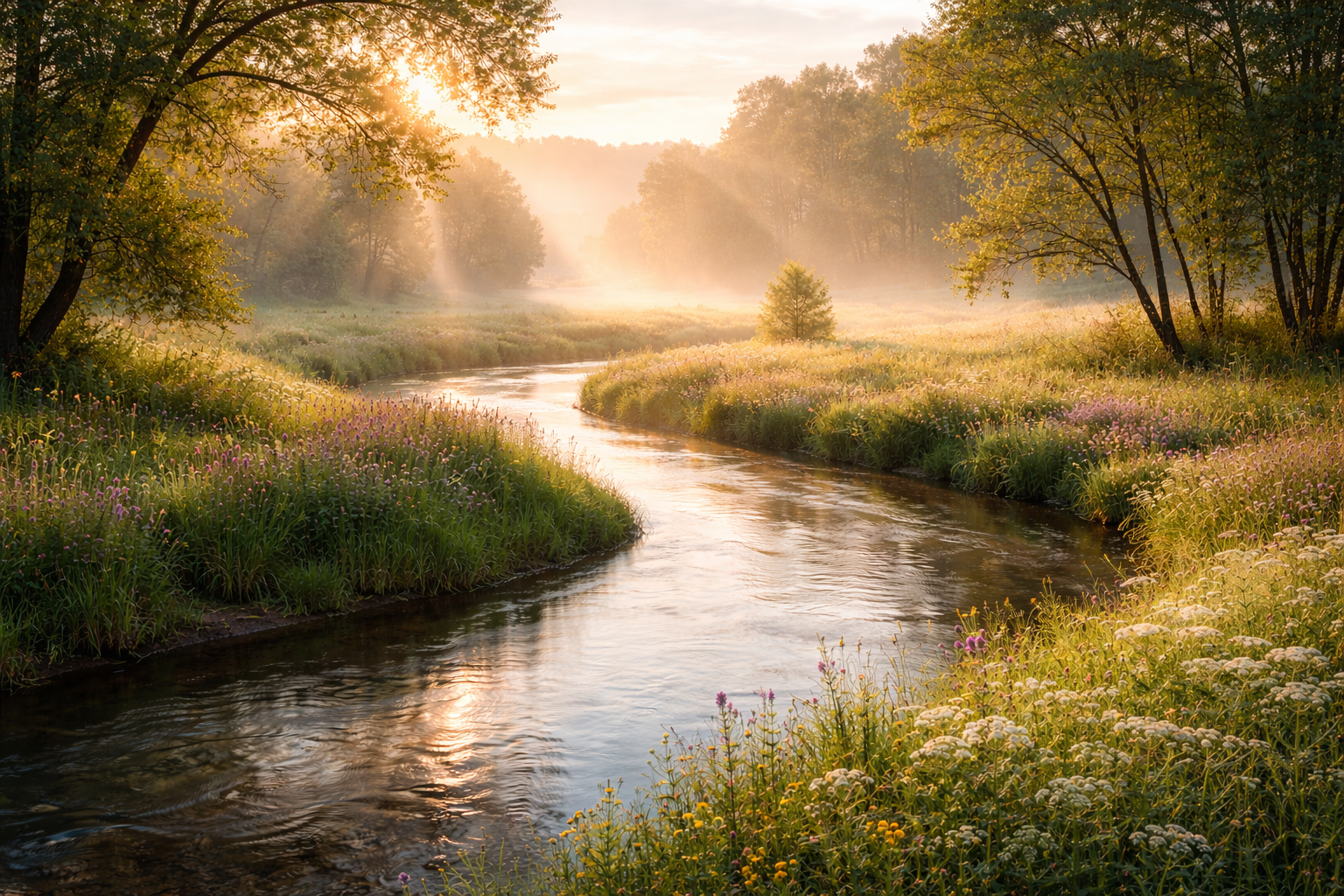
A river is soft and vulnerable. It is exposed to the terrain, to drought, to storms. Falling branches and shifting earth stir her up and shape her. She cannot harden herself into stone. She cannot withdraw into a sealed container. Her very nature is to move.
And yet, a river is not weak.
She has a riverbed — the ground that shapes and holds her. Without that ground, water disperses into a swamp or a flood. With it, the river flows with clarity.
The river responds to obstacles, curving around rocks, deepening in certain places. She narrows and widens. She accepts what enters it — rain, other streams, leaves — and integrates it into her movement. She does not fight the mountain but finds her way through it or around it.
There is both softness and power in a river. It yields, yet over time it shapes stone. She is in constant contact with her environment, yet she does not lose her direction. She moves toward even larger waters.
Clean vulnerability is like this. It is a movement with the ground.
When I am grounded in Presence, when I can feel my breath, my body, the support beneath me, my vulnerability flows rather than floods.
If grief comes, it moves like water along a riverbed that can hold it.
If fear arises, it is felt as current, not as catastrophe.
If joy appears, it bubbles from the depths and sparkles on the surface.
The river does not deny her vulnerability to vanishing or flooding. She does not pretend to be a rock. She does not collapse into formlessness. She trusts her ground and her movement. And perhaps most importantly: the river nourishes life in her depths and along its banks. Where she flows, things grow.
Going Slower to Feel the Riverbed
To practice embracing our vulnerability, we must slow down. We must feel the riverbed.
Before speaking, we pause. We sense our feet. We notice the breath moving in and out. We allow whatever feels vulnerable, tender, soft, and uncertain to show itself internally, so it can feel that it belongs. What is vulnerable is often not fragile in the way we fear. It is sensitive. It is alive. It carries intelligence. If we listen, we will hear what it needs.
Sometimes it needs silence.
Sometimes a boundary.
Sometimes tears.
Sometimes words — carefully spoken.
When vulnerability is first held inside with kindness, expression becomes cleaner. It is no longer a demand. Sharing it becomes an offering. And because we are internally rooted, the response of others does not determine our stability. We can remain open and steady even if they do not understand.
Growth and the Softening of Armour
Growth requires vulnerability.
Children grow because they are permeable. They are open to influence, experience, correction, and wonder. Their vulnerability is not yet heavily defended.
As we mature, we often build armours, sometimes out of necessity. Life can be harsh. Rejection hurts. Failure stings. Loss devastates. But if the armour remains too long, growth slows. Rigid structures may look strong, but they are brittle and crack in storms of life. They also divide us and isolate us. We become strong and alone…
To grow, something must soften. This softening is not regression. It is maturation. It is the willingness to remain open even when we know that openness includes the possibility of hurt. It is trusting that our inner ground, our riverbed, can hold what arises. And find its flow again and again…
Vulnerability as Relational Field
Vulnerability is not only an internal experience. It is relational.
When I meet my own vulnerability with Presence, I become more capable of meeting yours. If I am not terrified or ashamed of my own tenderness, I do not need to fix yours. I do not need to dismiss it, judge it, or rush it away.
Clean vulnerability creates space with connection. It allows two nervous systems to remain in contact without collapsing into each other or withdrawing. In this way, vulnerability becomes a field of connection and interconnectedness rather than something to hide or a burden to manage.
It becomes a place where authenticity can arise.
A place where creativity is born because creativity requires risk. It requires showing something that may not be fully formed, may feel unfamiliar, strange, or difficult to understand at first. It requires allowing ourselves to be seen.
Without vulnerability, there is no intimacy.
Without vulnerability, there is no real dialogue.
Without vulnerability, there is no new life.
The Birth of Compassion
And here, something deeper reveals itself. When vulnerability is held, neither suppressed nor spilled, compassion naturally emerges.
Compassion is not a technique. It is not a moral obligation. It is the resonance with our shared humanness that arises when we are in contact with vulnerability, our own and others’, without defence.
If I close my heart to avoid being hurt, I also close it to compassion. If I drown in my own pain without ground, I may become consumed and unable to see beyond it. But when vulnerability flows like a river within a stable holding of Presence, the heart remains open. And in that openness, I begin to recognise something shared.
Your fear is not foreign to me.
Your grief echoes my own.
Your longing mirrors mine.
Compassion is born in this recognition.
It is the quiet knowing that we are walking the same terrain of impermanence and care. The more intimately I meet my own vulnerability, the less I need to defend against yours. The more gently I hold my own pain, the more space I can offer you when you hurt. In this way, vulnerability becomes not only a personal experience but a bridge, and our rivers connect us…
Living with a Soft Front and Strong Back
I have discovered that it hurts me more when my heart is closed than when it remains open.
Yes, an open heart sometimes aches. But when I live with a soft front and a strong back, that ache is held. The soft front allows feeling. The strong back provides inner support. Then, heartbreak becomes not an endpoint but a passage.
As the teaching attributed to Rumi reminds us, “The wound is the place where the Light enters you.” Grief, when met with openness, becomes the garden of compassion.
This does not romanticise suffering. Pain is real. Loss is real. When love was real, and something ended, the grief would be there. But when vulnerability is grounded in concentric circles of Presence (remember the image of Babushka dolls), pain deepens rather than diminishes us. It carves space in the heart.
And in that space, compassion grows.
An Ongoing Practice
This way of living with vulnerability is not a destination. It is an ongoing practice.
We will armour again. We will flood again. We are human. But perhaps we can begin to notice. The next time vulnerability arises — in a conversation, in disappointment, in longing — pause.
Feel your feet and the support of the ground below. It is always there... Sense the breath.
Let the river gather within its banks.
Ask quietly: What does that something inside need from me?
Not from others first. From me/you, from within.
And then, let the words or images come from that something inside.
You may discover that vulnerability is not something to overcome. It is the current of aliveness itself.
And when it flows cleanly — grounded, open, held — it becomes the source of compassion, connection, and growth.
Like a river moving steadily toward the sea, shaping and nourishing life along the way.
An Invitation
In my upcoming workshops, we will explore and expand this practice together — not as a concept, but as a lived, embodied experience.
This work is about becoming more real, more internally supported, integrated and whole.